
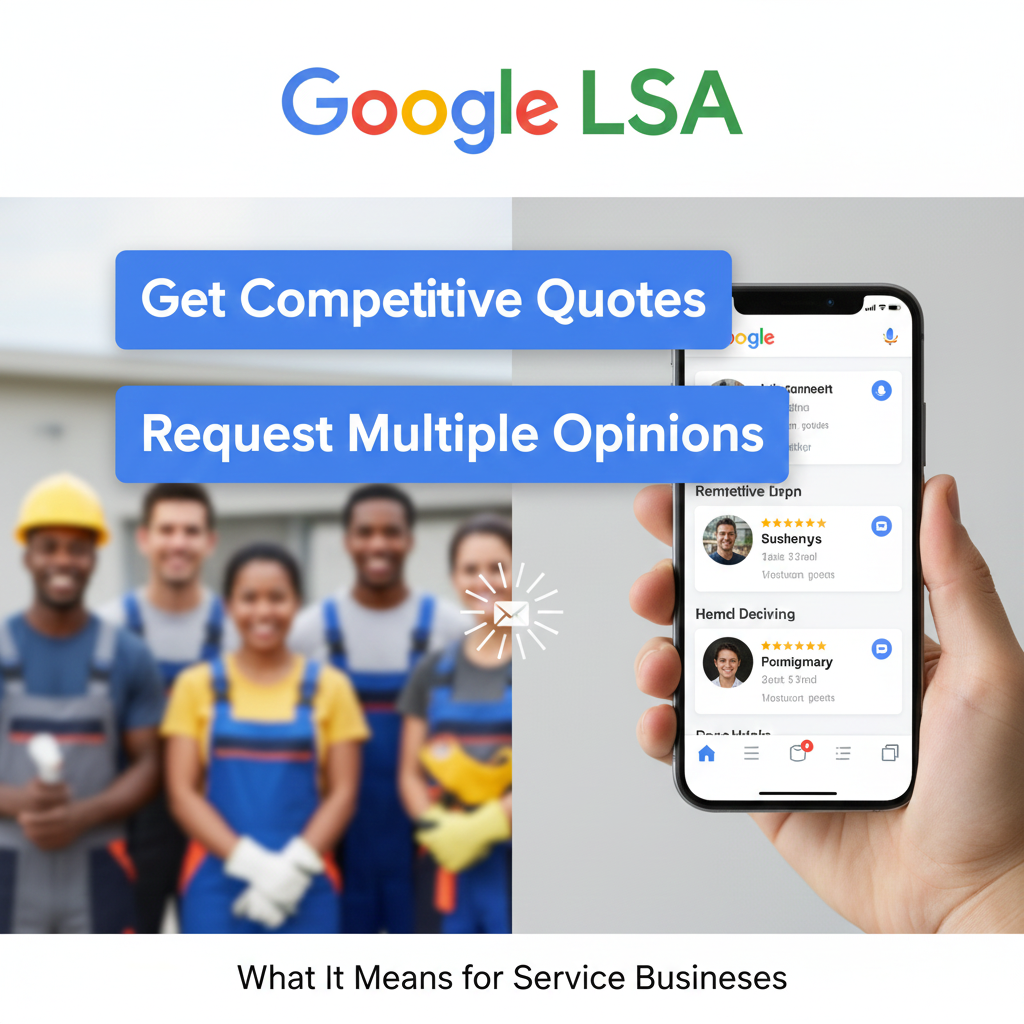
If you run local service ads on Google, there’s a big change on the horizon — and it could shake up how leads are generated, delivered, and billed.
Recently Google started testing two new features inside Local Services Ads: “Get Competitive Quotes” and “Request Multiple Opinions.”
✅ What Are These New Buttons
- The “Get Competitive Quotes” button allows a user to request estimates from multiple businesses at once — instead of selecting just a single provider.
- The “Request Multiple Opinions” variation appears to function similarly, offering a “message-fan-out” that delivers the quote request simultaneously to multiple providers.
- What this means: when a customer is looking for a contractor (plumber, tree service, HVAC, etc.), they may no longer contact just one business. Instead, they can shotgun the request to several at once — with one click.
⚠️ Why This Is a Big Headwind for Service Providers
As someone managing LSA campaigns for businesses — as we do at Steady Demand — this update introduces real risks:
- Leads may be shared among competitors. When one request goes to several businesses, you might be bidding or paying for the same lead as 2–3 competitors.
- Faster responders and lowest bidders win. In a shared-quote environment, the business that replies fastest — or undercuts others on price — is likely to get the hire, turning what used to be a “qualified lead” into a potential bidding war.
- Uncertainty around lead billing and ROI. It’s not yet fully clear whether every business gets charged for a shared-quote lead or what Google’s lead-billing rules will be when this becomes widespread.
- Potential drop in lead quality and conversion rates. Because consumers are contacting multiple vendors at once, some requests may come from people “just shopping around” — increasing the number of cold leads for providers.
📊 What Early Data & Industry Reports Say
- One recent blog post evaluating the “Competitive Quotes” feature notes that only businesses with messaging enabled, good reviews, quick response times, and full profile optimization get shown in the multi-quote selection list.
- The same post warns that companies may be charged for leads that don’t convert — meaning your cost per acquisition (CPA) could rise without a proportional increase in jobs.
- Other local-service advertisers (legal, plumbing, home maintenance) are already bracing for increased competition and potentially reduced lead exclusivity.
🎯 What Service Providers Should Do Right Now
If you’re running LSAs or thinking about launching them, here’s how to adapt:
- Enable messaging and keep response times lightning-fast. Responsiveness likely becomes more important than ever.
- Segment “shared-quote” leads vs. traditional single-lead requests. Track them separately to understand true lead quality, conversion rate, and cost per acquisition.
- Focus on value, not just price. When users shop multiple providers at once, competing only on price can erode margins. Emphasize service quality, reputation, and trust signals — not just the lowest bid.
- Monitor your LSA dashboard carefully. Watch for changes in lead volume, lead cost, and lead-to-conversion rate. If you see spikes in cost or reductions in booking rates, you may need to adjust your strategy (or budget).
- Consider lead-qualification filters. Not every quote request will turn into a job. Have intake systems (screens, questions) to pre-qualify leads before committing resources.
🧠 What This Means for Steady Demand Clients
As your LSA management partner, we’re keeping a close eye on this rollout. From what we see so far:
- The “Get Competitive Quotes” update is designed to benefit consumers — but for advertisers, it demands faster response, tighter lead handling, and smarter follow-up workflows.
- This could reduce exclusivity of leads, but with disciplined management, proper tracking, and optimized workflows, it’s still possible to maintain strong ROI — especially if you focus on value + customer experience, not just price.
- We recommend proactively tracking shared-quote leads, measuring their conversion rates vs standard leads, and adjusting your LSA budget and bidding strategy accordingly.
