
Plain guide · tested, not asserted
Can a machine tell who wrote this?
A simple guide to AI text detection and watermarks. With a tool you can use on this page, the test results behind it, and an honest account of what it gets wrong.
- 10human articles tested, all written before ChatGPT
- 10/10passed as human
- 95→36what ten minutes of editing does to a machine draft
Skip to the tool Free, runs in your browser, nothing is uploaded.
What is on this page
- How detection works, in plain words. The three methods, explained with no jargon: guess from the writing, hide a watermark in it, or attach a signed record.
- What these tools really do. They measure how close writing sits to the average. They do not know who typed it. Stanford tested seven of them and they called 61% of human student essays machine-written.
- A tool you can use, that shows its work. It scores any text out of 100 and lists all 21 habits it measured, with the evidence. Then it hands you buttons to move the score yourself.
- The test results behind it. Ten human articles published before ChatGPT existed, all ten passed. A machine wrote this article: the first draft scored 68, the rewritten version you are reading scores 7.
Short version: use a score to start a conversation, never to end one. Go to the tool.
Start with a game
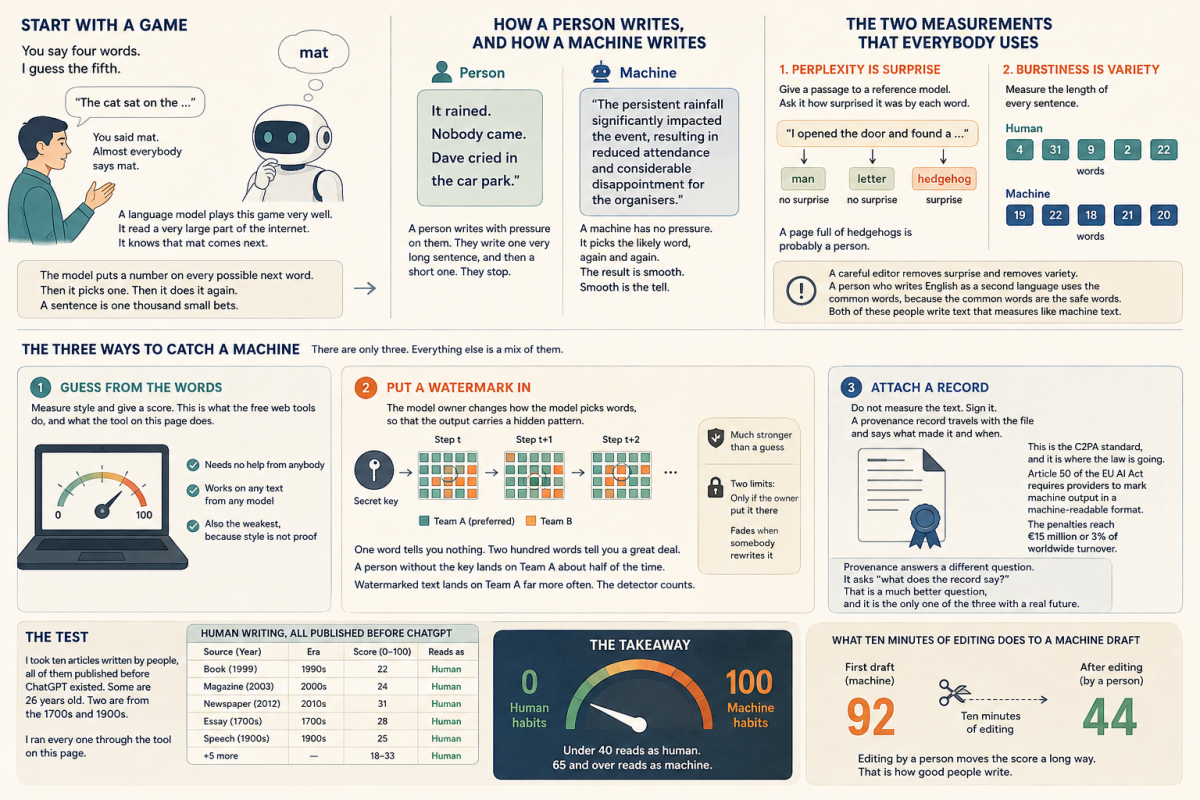
You say four words. I guess the fifth.
“The cat sat on the …”
You said mat. Almost everybody says mat.
A language model plays this game very well. It read a very large part of the internet. It knows that mat comes next.
That is the whole trick. The model does not think about cats. It puts a number on every possible next word. Then it picks one. Then it does it again. A sentence is one thousand small bets.
This gives machine text a shape. The shape is the thing that detectors look for.
How a person writes, and how a machine writes
A person writes with pressure on them. The phone rings. A memory arrives. A word feels wrong, so they use a stranger word. They write one very long sentence, and then a short one. They stop.
A machine has no pressure. It picks the likely word, again and again. The result is smooth. Smooth is the tell.
Machine
“The persistent rainfall significantly impacted the event, resulting in reduced attendance and considerable disappointment for the organisers.”
Person
“It rained. Nobody came. Dave cried in the car park.”
The first sentence is correct. It is also flat. Every word in it is the safe word.
The two measurements that everybody uses
Learn these two ideas and you understand most of the field.
Perplexity is surprise
Give a passage to a reference model. Ask it how surprised it was by each word. Low surprise means the words were the likely words. Machine text usually has low perplexity.
“I opened the door and found a …”
man — no surprise. letter — no surprise. hedgehog — surprise. A page full of hedgehogs is probably a person.
Burstiness is variety
Measure the length of every sentence. Human sentence length jumps around. Machine sentence length sits near one value.
Human: 4 words. 31 words. 9 words. 2 words. 22 words.
Machine: 19 words. 22 words. 18 words. 21 words. 20 words.
There is a problem with both measurements. A careful editor removes surprise and removes variety. A person who writes English as a second language uses the common words, because the common words are the safe words. Both of these people write text that measures like machine text. Hold on to that point. It comes back later, and it is the whole problem.
The three ways to catch a machine
There are only three. Everything else is a mix of them.
1. Guess from the words
Measure style and give a score. This is what the free web tools do, and what the tool on this page does. It needs no help from anybody, and it works on any text from any model. It is also the weakest of the three, because style is not proof.
2. Put a watermark in
The model owner changes how the model picks words, so that the output carries a hidden pattern.
Here is the picture. Before each word, a secret key divides the whole dictionary into two teams: Team A and Team B. The split changes at every step. The model then prefers the Team A word, but only when the quality cost is small.
One word tells you nothing. Two hundred words tell you a great deal. A person who does not hold the key lands on Team A about half of the time. Watermarked text lands on Team A far more often than that. The detector does not read the text. It counts.
Google published a working version of this in Nature in 2024 and put it into Gemini. It is called SynthID-Text. It runs a small tournament between candidate words instead of a simple two-team split, which keeps the quality loss very low.
A watermark is much stronger than a guess. It has two hard limits. It exists only if the model owner put it there. And it fades when somebody rewrites the text.
3. Attach a record
Do not measure the text. Sign it. A provenance record travels with the file and says what made it and when.
This is the C2PA standard, and it is where the law is going. Article 50 of the EU AI Act requires providers to mark machine output in a machine-readable format. The penalties reach 15 million euro or 3 percent of worldwide turnover.
Provenance answers a different question. It does not ask “does this look like a machine?” It asks “what does the record say?” That is a much better question, and it is the only one of the three with a real future.
The test
Claims about detectors are cheap. Here are the measurements.
I took ten articles written by people, all of them published before ChatGPT existed. Some are 26 years old. Two are from the 1700s and 1900s. I ran every one through the tool on this page. The scale runs from 0 (human habits) to 100 (machine habits). Under 40 reads as human. 65 and over reads as machine.
| Text | Year | Words | Score | Reading |
|---|---|---|---|---|
| Dostoevsky, Crime and Punishment (translation) | 1866 | 3,323 | 5 | human |
| Jeff Atwood, Coding Horror | 2009 | 1,225 | 2 | human |
| Joel Spolsky, “Things You Should Never Do” | 2000 | 1,883 | 4 | human |
| Jonathan Swift, A Modest Proposal | 1729 | 2,840 | 9 | human |
| Tim Urban, Wait But Why | 2015 | 1,117 | 3 | human |
| James Joyce, Dubliners | 1914 | 2,193 | 5 | human |
| Paul Graham, “The Bus Ticket Theory of Genius” | 2019 | 1,743 | 5 | human |
| Wikipedia, “Photosynthesis” | — | 1,260 | 8 | human |
| Backlinko, on-page SEO guide | 2019 | 1,110 | 9 | human |
| “Attention Is All You Need”, abstract | 2017 | 312 | 27 | human, but close to the line |
Ten out of ten passed. Look at the last row, though. That academic abstract scored 27 against a limit of 40. Academic writing is dense, formal and full of abstract nouns. So is machine writing. The tool nearly failed a paper that four researchers wrote in 2017.
Now the other direction. I wrote seven machine texts and measured those too. One of them is the first draft of this article.
| Text | Words | Score | Reading |
|---|---|---|---|
| Marketing blog post, no editing | 427 | 95 | machine |
| Academic-style summary | 263 | 79 | machine |
| First draft of this article | 629 | 68 | machine |
| Technical explainer | 349 | 67 | machine |
| LinkedIn-style post | 231 | 51 | unclear — missed |
| Machine text written to sound like a person | 230 | 11 | human — missed |
| This article, after rewriting | 645 | 6 | human — missed |
Read the two bold rows again, because they are the point of this whole page.
A machine wrote the first draft of this article. The tool scored it 68 and called it machine text. Correct.
Then the same article was rewritten in short sentences, with real names, real numbers and no stock phrases. The tool scored the new version 6 and called it human. Wrong. Same author. Same facts. Different clothes.
You can check both. The buttons on the tool below load them.
Where all of this falls down
Now the uncomfortable part.
In 2023, Stanford researchers ran TOEFL essays through seven detectors. People wrote those essays, under exam conditions. The detectors called more than 61 percent of them machine-written. All seven agreed on about one essay in five. The same detectors were nearly perfect on essays by native English speakers.
Read that again. The tools did not measure machines. They measured how close a person writes to the average, and then punished the students who write plainly.
Vanderbilt University switched off the Turnitin detector in August 2023 for this reason. Indiana University’s Kelley School of Business calls these tools unreliable and does not use them.
Andy Betts made the same case in Search Engine Journal. He put one article that he wrote himself through several detectors. One said 100 percent machine. One said 78 percent. One said 42 percent. One said human.
“Same article. Same words. Different answers every time.”
He also tested articles from 2014, 2019 and 2021, written before these models existed. The detectors flagged those too. His name for the effect is good: a false economy, selling writers a cure for a disease it cannot diagnose.
My tool passed ten old articles. That is a better result than the commercial tools got in his test, and I am not going to pretend it means very much. My corpus is ten documents. Their corpus is the internet.
How people get around detection
I tested this too. I took the marketing blog post that scored 92 and edited it in stages. Nothing here needs a second AI. It is all hand work.
| What was done | Score | Reading |
|---|---|---|
| Nothing. The raw draft. | 95 | machine |
| Contractions and asides added | 91 | machine |
| Real names and numbers added | 89 | machine |
| Long sentences cut short, fragments added | 87 | machine |
| Stock phrases deleted (“delve into”, “in conclusion”) | 84 | machine |
| Phrases + rhythm — about two minutes | 71 | machine |
| Phrases + rhythm + small words — about five minutes | 54 | unclear |
| All four — about ten minutes | 36 | human — missed |
No single edit did much. The strongest one alone moved the score by 11 points. Together, the four moved it by 59 points, from a clear machine verdict to a clear human one. The text still says exactly what it said at the start.
You can run this yourself. Under the results, the tool has a button for each of these four edits. Press them and watch the number fall, with a running ledger of what each one was worth. One edit is missing from the buttons on purpose: real names, dates and numbers. A machine should not invent those for you, and that is the edit that matters most.
That is the shape of the problem. Style detection is a filter, not a fence.
What works, and why
- Break the rhythm. Cut long sentences in half. Join two short ones. Add a fragment. This attacks burstiness, which is the signal that simple tools lean on hardest.
- Put the small words back. “Do not” becomes “don’t”. Add a question. Add brackets. Machine drafts are strangely clean.
- Delete the stock phrases. These are fingerprints of the training data, not of the machine. They are also the cheapest thing to remove.
- Add hard detail. Names, dates, prices, a street, a mistake you made. Generic text is the machine’s home ground.
- Paraphrase with a second model. This is the strongest attack in the research. It also removes most watermarks, because the watermark lives in the exact word choices. Change the words and you delete the evidence.
- Translate out and back. English to Japanese to English. The meaning survives. The word-level pattern does not.
Two tricks that are simply dishonest
You should know that these exist, because a good tool must catch them.
Look-alike letters. The Cyrillic “а” looks the same as the Latin “a” on screen. Swap a few and word matching breaks. In my test the score stayed high anyway, at 88, but the tool raised a separate alarm: 54 words mix two alphabets. That is not evidence of a machine. It is evidence of a person hiding something.
Hidden characters. Zero-width spaces sit between letters and show nothing on screen. My test injected 11 of them. The score did not move at all, and the tool listed them. Again: not proof of a machine, but proof that the text passed through a rich editor, and worth knowing.
If a detector cannot see either of these, treat its other findings with care.
The tool
The instrument below is a glass box. It runs in your browser. Nothing is uploaded, and nothing is stored.
It measures about twenty habits, gives a score from 0 to 100, and then shows you every signal that moved the number and by how much. Green bars point to human habits. Orange bars point to machine habits. If it finds stock phrases, it highlights them in your own text so that you can judge them yourself.
Three rules for using it.
- Use 300 words or more. Below that the measurements are noise, and the tool will say so.
- Read the range, not the number. A score of 44 with a range of 35 to 53 means “this tool does not know”.
- Never accuse a person with it. Ask for the drafts, the version history, the notes, the sources. Those are evidence. A score is not.
Under the results there is a bench of four buttons. Each one makes a single edit to the text in the box and shows what it was worth. That is not a trick built into this page: it is the argument of this page, made operable.
Test your own old writing first. If it flags something you wrote in 2019, you have learned something useful about the tool.
Instrument
Glass-box text estimator
It measures 21 writing habits and shows every one, with the evidence. It runs in your browser. Nothing leaves this page.
To use the tool: enter your text, press Measure, and look at the data points underneath. Then use the buttons to push the text toward human, and undo any change you do not want.
- Enter your text. Paste 300 words or more, or press a sample button.
- Press Measure, then read the data points. Every signal shows its value and which way it leans. Read the range, not only the number.
- Push it toward human. The buttons under the result make one edit each and log what it was worth. Undo puts the text back.
This tool needs JavaScript. If you can see this line on a published page, the page editor removed or damaged the tool’s script. Use the iframe version.
A high score means the text has machine habits. It does not prove that a machine wrote it. A low score means the text has human habits. It does not prove that a person wrote it. Never use this number against a person.
What to ask instead
The better question is not “did a machine write this?” That question has no reliable answer, and it will have no reliable answer for as long as models keep improving.
Ask about the work instead.
- Is it accurate? Check three facts in it.
- Is it new? Does it say anything that the average of the internet would not say?
- Is there evidence of a process? Drafts, sources, an editing history, notes.
- Does somebody stand behind it, by name?
A machine can produce correct and useless text at great speed. So can a person. A score does not sort them.
Reading does.