
Google’s Fused Mobile Local AI Overview: What It Means for Your Small Business
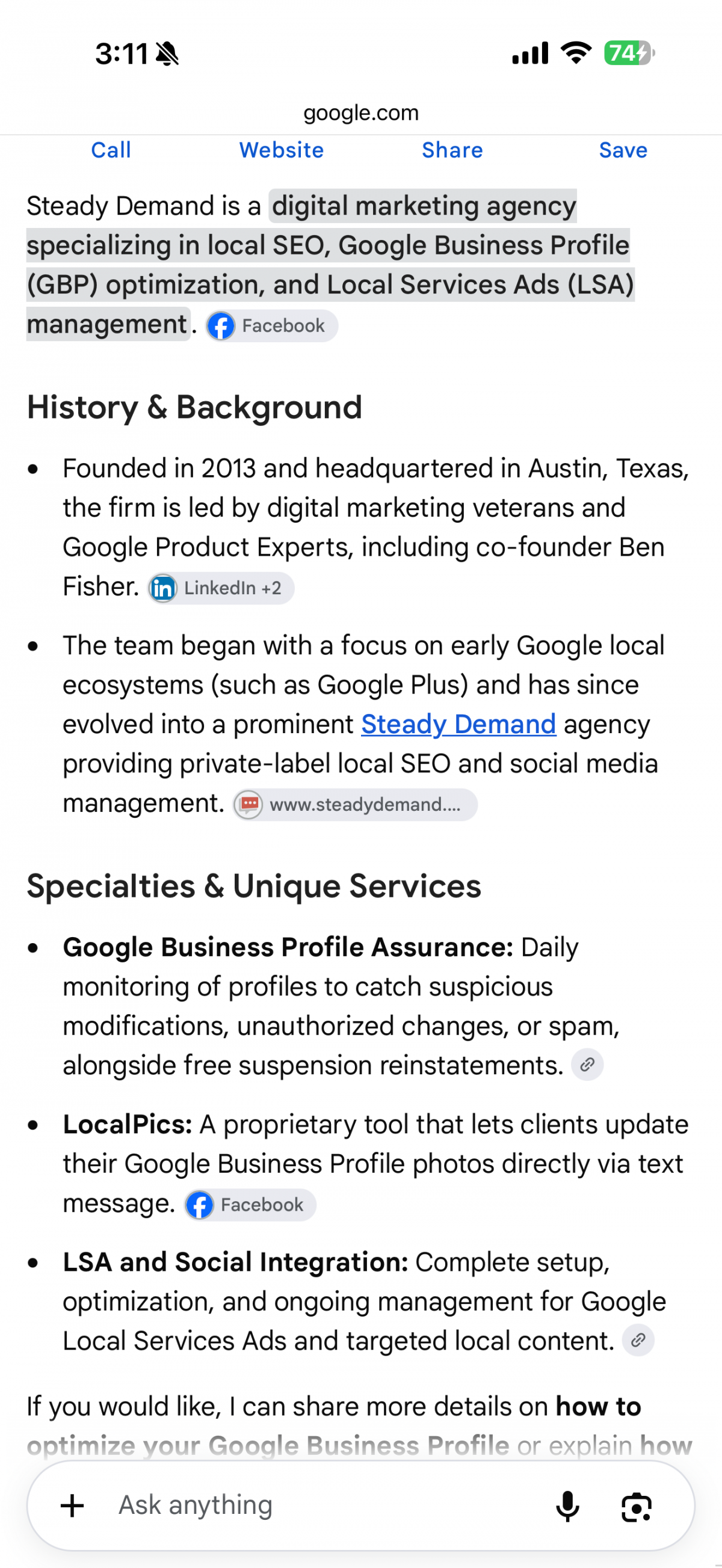
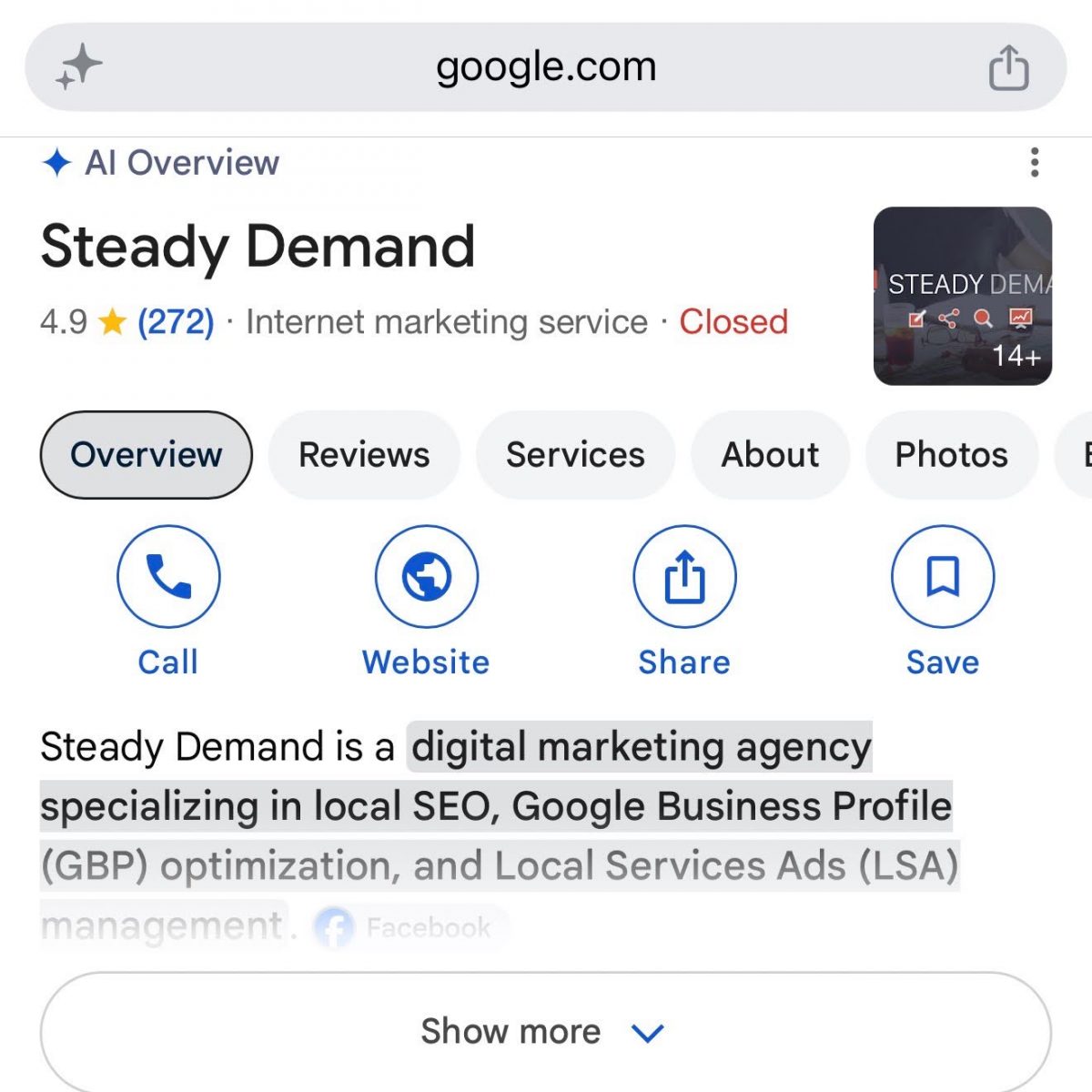
Google rolls out local search updates constantly. Some make waves; others fly under the radar. But there’s a big shift happening right now on mobile: AI-generated business overviews fused directly into Google Business Profiles (GBP).
Right now, roughly a quarter of local businesses show an AI Overview when you search their exact brand name. Most of the time, Google embeds this summary straight into the GBP panel itself.
When I double-checked these results against real mobile phone searches, I caught Google confidently naming the wrong business multiple times.
This feature isn’t ready for primetime across all local businesses. Here is a breakdown of what I tested, what the data shows, and where the system breaks down.
What I Actually Measured
Before diving into numbers, context is key.
I sampled 100 real local brands across ten service industries (plumbers, dentists, barbers, movers, tire shops, gyms, restaurants, and more), balancing multi-location regional chains with single-location independents. For every business, I ran four standardized mobile searches anchored to New York on the same day: the exact business name, “[business name] reviews,” “is [business name] legit,” and “what does [business name] do.”
That’s one search per brand per query format, no repeat sampling, no rolling weekly averages. That constraint matters, and I’ll explain why shortly.
Before running a single query, I locked in two baseline metrics: the percentage of brand-name searches triggering an overview, and the percentage triggered across any of the four search variations. Setting criteria upfront prevents confirmation bias. Everything else documented here, the fused layout split, citation sources, manual phone verification, stems from direct observations in the wild.
The Big Number to Note
One in four tested brands (26%) triggered an AI Overview on a plain brand-name query, the exact search a customer runs when evaluating a local business before calling.
Slightly broadening the query (adding “reviews” or “is it legit”) pushed overview coverage to 99 out of 100 brands across at least one query variation. However, that’s a ceiling effect, not a primary takeaway; ask enough variations, and an AI block eventually triggers. The plain brand search is the benchmark that matters most because it reflects real consumer search intent.
When overviews triggered, four out of five merged directly into the business panel, nesting aggregate ratings, operating hours, call buttons, and website links inside the AI card. While dominant in this dataset, ongoing testing will confirm whether this becomes the permanent standard.
Let’s be direct: what Google calls an entity card is powered by your Google Business Profile. Ratings, hours, photos, and CTA buttons come directly from your GBP listing. When fused, Google renders your profile inside the AI Overview block. Inaccurate profile data no longer just looks messy; it distorts the primary AI summary customers read about your business.
Another critical distinction: the 26% triggering rate was specific to mobile searches. Running identical brand searches on desktop yielded AI Overviews on just 6% of queries. If you only audit your local presence on desktop browsers, you are missing what mobile searchers see.
Initial observations also indicate multi-location businesses often skipped triggering AI overviews, whereas single-location entities triggered them far more consistently. Google appears to favor singular entity clarity before outputting a synthesized AI narrative.
Where You Get Left Out of Your Own Answer
Clarifying terminology: AI Overviews represent the default AI panels on standard Google search result pages. AI Mode refers to Google’s conversational search interface. For citation source analysis, data was drawn specifically from AI Mode responses.
These citation findings directly impact how you manage off-site brand authority.
For brands holding the #1 organic position for their exact business name, 74% were not cited when AI Mode answered direct questions about them. Ranking #1 organically does not guarantee your site serves as the AI’s reference source.
Across brand query sets, third-party platforms outranked official brand websites in 59% of AI citations. Yelp, Reddit, Trustpilot, and Google Review data drove the vast majority of references. (Note: Raw datasets showed 84%, but adjusting for generic brand names like “Life Time” or “Row House” yields a calibrated 59% baseline metric).
| Source | Citations | Brands |
|---|---|---|
| Yelp | 118 | 72 |
| Google (reviews/maps) | 109 | 60 |
| 91 | 58 | |
| Trustpilot | 77 | 52 |
| Better Business Bureau | 39 | 33 |
| Wikipedia | 35 | 28 |
The practical takeaway: sentiment and information published on Yelp, Reddit, and Trustpilot heavily shape AI Mode answers for trust-based queries. Auditing external platform sentiment is essential for local brand management.
Where this Fell Apart when I Checked It by Hand
Automated API tracking provides scale, but manual cross-verification reveals real-world discrepancies.
Initial metrics relied on vendor API data. To validate accuracy, I spent a week performing manual mobile verifications, testing brand queries directly on device screens against API outputs.
The API metrics proved generally reliable, but highlighted notable edge-case failures.
| What the API said | Phone checks | Confirmed | Reliability |
|---|---|---|---|
| No overview | 23 | 83% | Held up best |
| Fused layout | 23 | 74% | Mostly right |
| Plain overview | 13 | 62% | Weakest call |
Sample sizes ranged from 13 to 23 manual device checks per layout state. Focus on relative consistency: “No overview” calls were highly accurate, whereas “plain” overviews were least consistent.
API predictions for “No Overview” matched live mobile screens 83% of the time. The “Plain Overview” category showed the highest variance, driven by two underlying issues.
Issue 1: Entity Mismatch Errors
Exact brand-name searches triggered AI Overviews and entity panels for unrelated businesses in four tested instances. Searching “Fox Pest Control” generated an AI panel for Fox Wildlife Services. “Paragon Sports” produced results for Paragon Basketball Academy. “Sobo & Sobo” (legal firm) pulled Sobo Pools, and “Chapel Hill Tire” surfaced Big Brand Tire & Service.
When a target business lacks local geographic proximity to the searcher, Google often defaults to the nearest phonetically or semantically similar entity name, presenting incorrect information without disclaimers or visual warnings.
“Fox Pest Control” returned an AI Overview for Fox Wildlife Services, a real, different company, down the road. Same category, wrong business, no warning.
If your business name shares terms with other entities, audit your brand searches outside your immediate service territory to verify how Google resolves your brand entity.
Issue 2: Search Result Volatility
Running identical searches hours apart yielded shifting layout states. A brand query shifted from displaying no overview to displaying a fully fused panel within hours. Tracking a national moving brand over three days showed three distinct layout variations (fused, none, plain) for the exact same query.
Single search audits represent temporary snapshots rather than permanent positions. Verify brand queries multiple times across different days before drawing conclusions.
What I’d Do With This Information
If your business displays incorrect information in AI features, resolve the underlying source data. AI models pull from cited web references; correcting inaccurate hours, addresses, or brand details on your GBP profile, Yelp, or third-party directories directly updates the source layer feeding the AI summary.
- Audit mobile brand queries incognito: Test exact business name searches on mobile devices while logged out of Google accounts to view unpersonalized results.
- Identify cited source paths: Examine citation links inside AI overviews to determine which external profile or page requires correction.
- Account for SERP volatility: Re-run brand audits across different times of day to confirm layout behavior.
- Check entity overlaps: Test queries from secondary markets to verify whether Google confuses your brand name with ad